You get up to make tea, and your dog gets up too. You walk to the bathroom, and there are paws behind you. You move from the sofa to the kitchen, and your shadow has four legs. If you have ever asked yourself, “Why does my dog follow me everywhere?” — you are not alone. It is one of the most common questions dog owners ask, and in most cases, the answer is actually a compliment.
Following you around is usually a sign of a strong bond, not a problem. Dogs are social animals who naturally want to be near the people they trust. But sometimes constant shadowing can point to boredom, anxiety, or even a health issue that needs attention. In this guide, we will walk through the nine most common reasons dogs follow their owners, how to tell the difference between normal affection and a real problem, and simple ways to help your dog feel confident being on its own.
The Short Answer: Why Dogs Follow You Everywhere
Dogs follow their owners because they see you as their family, their source of food and fun, and the center of their world. For most dogs, staying close is simply natural pack behavior. It only becomes a concern if your dog panics when you leave, cannot settle alone, or suddenly starts following you much more than usual — which can be a sign of anxiety or illness.
Let us look at each reason in detail, so you can figure out which ones apply to your dog.
1. Dogs Are Pack Animals — and You Are Their Family
Wild dogs and wolves live and travel in groups. Staying close to the group means safety, warmth, and a better chance of finding food. Your domestic dog still carries those instincts. When your dog follows you from room to room, it is doing exactly what thousands of years of evolution trained it to do: stick with the pack.
In your home, you are the pack. Your dog does not see you as a “master” in the old-fashioned sense — modern research shows dogs form attachment bonds with their owners that look a lot like the bond between a child and a parent. Following you is simply how your dog says, “You are my person, and I want to be where you are.” For most dogs, this is healthy, normal, and honestly one of the sweetest parts of owning a dog.
2. You Are the Source of Everything Good
Think about it from your dog’s point of view. Who fills the food bowl? Who opens the door for walks? Who throws the ball, gives the treats, and scratches the perfect spot behind the ears? You do. From your dog’s perspective, you are a walking vending machine of all the best things in life.
Dogs are excellent at learning cause and effect. If following you to the kitchen sometimes results in a dropped piece of cheese, your dog will happily keep following you to the kitchen. If getting up from your chair often leads to a walk, your dog will watch your every move for the first sign of it. This is not manipulation — it is just smart learning. Your dog has figured out that good things happen near you, so near you is exactly where it wants to be.
3. Your Dog Has Learned Your Routine
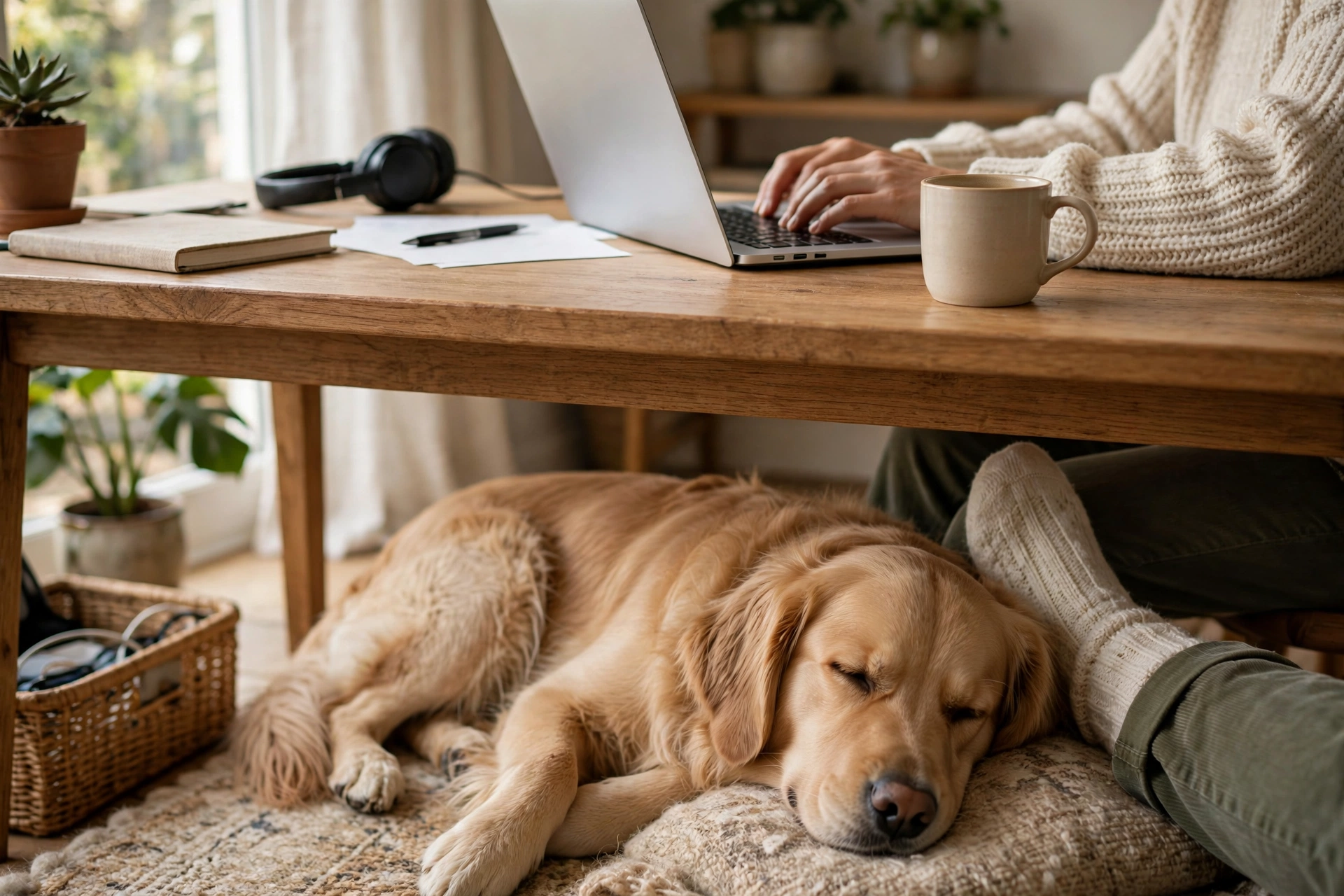
Dogs are creatures of habit, and they are surprisingly good at reading yours. They notice the sound of your keys, the shoes you wear for walks, the cup you use in the morning, even the way you close your laptop at the end of the workday. Over time, your dog builds a mental schedule of your day — and starts anticipating what comes next.
So when you stand up at 6 p.m., your dog is not being clingy; it is being prepared. It knows dinner, a walk, or playtime usually follows. This is why some dogs seem to follow you more at certain times of day. They are not following you randomly — they are following the routine they have memorized, and you are the most important part of it.
4. Simple Curiosity: You Might Do Something Interesting
Dogs experience the world through their noses and their eyes, and from a dog’s perspective, humans do fascinating things all day. We open doors, carry bags, make food, talk to invisible people on phones, and constantly move between rooms. Every time you get up, there is a chance something interesting is about to happen.
Following you is your dog’s way of staying informed. It is the canine version of checking the news. A dog that is mentally stimulated and curious about its environment will naturally want to see what you are up to — especially if your activities sometimes involve food, visitors, or going outside.
5. Your Dog Wants Attention and Affection
Some dogs follow simply because they love being close to you. Physical closeness — leaning against your leg, resting a chin on your foot, sleeping where they can see you — is how many dogs express affection and feel secure. If your dog follows you and then settles calmly nearby, that is usually just companionship.
There is a difference between a dog that wants to be near you and a dog that demands constant interaction. A content dog will follow you to the next room, lie down, and relax. A dog that paws at you, whines, or nudges you nonstop may be asking for more attention, exercise, or mental stimulation than it is currently getting. The following itself is not the issue — it is what your dog does once it arrives that tells the real story.
6. Some Breeds Are Natural “Velcro Dogs”
Certain breeds were developed to work closely alongside people all day, and they tend to stick to their owners like glue. These are often called “Velcro dogs.” Breeds commonly known for this include Labrador Retrievers, Golden Retrievers, German Shepherds, Border Collies, Cavalier King Charles Spaniels, Vizslas, and many toy breeds like Chihuahuas and Maltese.
Herding breeds follow because their job was to watch and move with livestock and their handler. Sporting breeds follow because they were bred to stay close to hunters. Companion breeds follow because being close to people is literally what they were created for. If your dog is one of these breeds, constant following is largely built into its DNA — and it is one of the reasons people love these breeds so much.
7. Puppies Follow for Safety and Learning
If your follower is a puppy, this behavior is completely expected. In the wild, puppies stay close to their mother and littermates for warmth, food, and protection. Your puppy has simply transferred that instinct to you. Following you is how a puppy learns about the world: what is safe, what is interesting, and how daily life works.
Puppy following usually decreases as the puppy grows, gains confidence, and becomes more independent — typically over the first year. You can help this process along by gently rewarding calm, independent behavior (more on that below) rather than carrying your puppy everywhere. A puppy that learns early that being alone for short periods is safe grows into a more confident adult dog.
8. Boredom or Not Enough Exercise
A dog with energy to spare will find something to do — and following you around the house is an easy choice. If your dog has not had enough physical exercise or mental stimulation, you become the most interesting thing in its day. This is especially common in young, high-energy dogs and in dogs left alone with nothing to do for long stretches.
Before assuming your dog has an anxiety problem, take an honest look at its daily routine. Most healthy adult dogs need at least one to two hours of combined physical exercise and mental activity per day, though the right amount depends on breed, age, and health. A tired dog is usually a relaxed dog — and a relaxed dog is far more likely to nap on its own bed than to trail you to the bathroom.
9. Anxiety or Feeling Unwell
Sometimes, following is your dog’s way of asking for help. Dogs that feel anxious — about storms, loud noises, changes in the home, or being left alone — often seek out their owners for comfort. A dog that suddenly becomes much clingier than usual may also be in pain or feeling unwell. Dogs cannot tell us what hurts, but a noticeable change in behavior is often the first clue.
If the change is sudden, or if clinginess comes with other signs like loss of appetite, restlessness, panting, drooling, or hiding, it is worth a visit to your veterinarian. Only a vet can rule out medical causes. The good news is that most clingy behavior has simple, harmless explanations — but a sudden change always deserves a professional opinion.
When Following Becomes a Problem: Signs of Separation Anxiety
There is an important difference between a dog that enjoys your company and a dog that cannot cope without it. Separation anxiety is a real condition where a dog becomes distressed when left alone or separated from its owner. Common signs include:
- Pacing, panting, drooling, or whining when you prepare to leave
- Destroying doors, windows, or furniture — especially near exits — when alone
- House soiling only when left alone, even in a fully house-trained dog
- Excessive barking or howling that neighbors report while you are out
- Refusing to eat treats or food until you return
- Frantic, over-the-top greetings that take a long time to settle
If your dog shows several of these signs, please talk to your veterinarian or a certified professional dog trainer who uses positive, reward-based methods. Separation anxiety is treatable, but it takes patience and a structured plan. Punishing an anxious dog only makes the fear worse, so kindness and consistency are essential.
How to Teach Your Dog Healthy Independence
Even if your dog’s following is harmless, teaching it to relax on its own is a valuable life skill — for both of you. Here are gentle, effective ways to build independence:
Reward calm behavior on a bed or mat
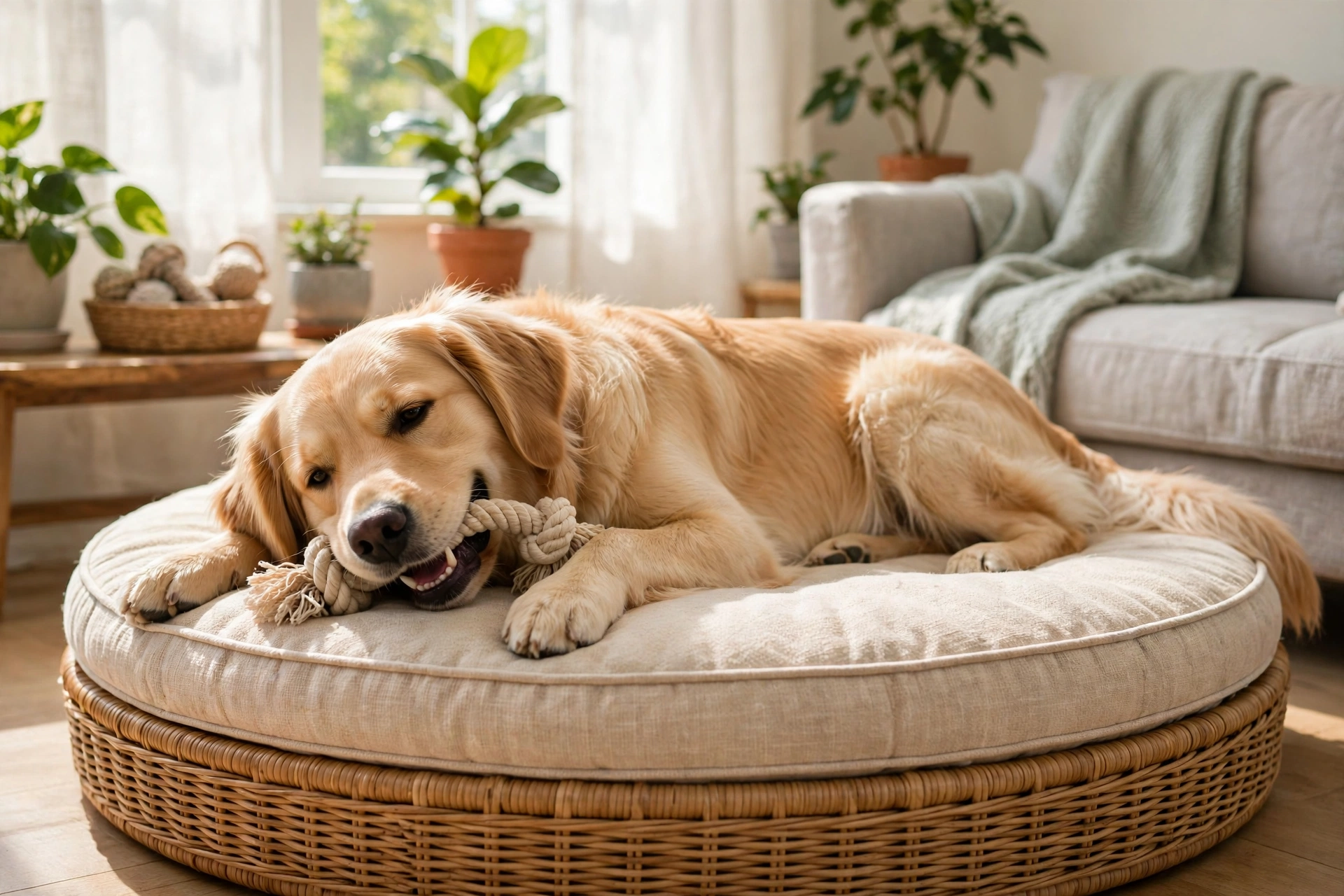
Teach your dog that its own bed is a wonderful place. Reward your dog with treats and praise for lying calmly on its bed while you move around the room. Start with very short distances and build up slowly. The goal is for your dog to learn: “Good things happen when I relax here, even when my person walks away.”
Practice short, boring departures
Pick up your keys, put on your shoes, step out for a few seconds, and come back — all without making a big fuss. Repeat this many times so your dog learns that your leaving is normal and you always return. Gradually increase the time you are gone, always staying below the point where your dog becomes distressed.
Give your dog a job to do
Puzzle feeders, snuffle mats, long-lasting chews, and treat-dispensing toys give your dog something enjoyable to focus on besides you. A dog busy working on a puzzle is learning that good things happen even when it is not glued to your side.
Make sure exercise and mental needs are met
A well-exercised dog settles more easily. Daily walks, play sessions, sniffing time, and short training games all help your dog feel satisfied — and a satisfied dog is much less likely to shadow you out of boredom.
Keep greetings and goodbyes low-key
Big emotional hellos and goodbyes can accidentally teach your dog that your comings and goings are a huge deal. Calm, brief greetings help your dog treat departures as ordinary events rather than dramatic ones.
Why Does My Dog Follow Me at Night?
Many owners notice the following gets worse in the evening. There are a few simple reasons for this. First, dogs are most active around dawn and dusk, so the evening hours are naturally their “awake and interested” time. Second, evenings are when the household routine winds down — dinner, television, getting ready for bed — and your dog has learned that these activities usually end with everyone settling in one place, often with your dog included.
Nighttime following can also be about security. In the dark, a dog’s vision is less useful, so staying close to its trusted person feels safer. Senior dogs in particular may become more attached at night as their eyesight and hearing fade. If your older dog has recently become much clingier after dark, mention it at your next vet visit — it is a common and manageable part of aging, and your vet can suggest ways to help your dog feel secure.
Frequently Asked Questions
Is it normal for my dog to follow me to the bathroom?
Yes, it is very common and usually normal. Dogs do not understand privacy, and the bathroom is simply another room where their favorite person has gone. As long as your dog is calm and relaxed, there is nothing to worry about.
Why does my dog follow me but not my partner?
Dogs often bond most strongly with the person who feeds them, walks them, and spends the most time with them. Your dog may simply see you as its primary person. This is normal and does not mean your dog dislikes anyone else in the home.
Why did my dog suddenly start following me everywhere?
A sudden change can be caused by a change in routine, a stressful event, aging, or a health issue. Older dogs may become clingier as their senses decline. If the change is sudden or comes with other symptoms, a vet check is a good idea.
Should I stop my dog from following me?
There is no need to stop normal following — it is a sign of a healthy bond. Instead of pushing your dog away, teach it to settle independently using the reward-based steps above. The goal is a dog that chooses to be near you, not one that feels it must be.
Do some dogs never grow out of following?
Many dogs happily follow their owners for their entire lives, especially companion and sporting breeds. As long as your dog is relaxed, can settle alone when needed, and shows no signs of distress, lifelong shadowing is simply part of its personality.
The Bottom Line
So, why does your dog follow you everywhere? In most cases, because you are its family, its routine, its entertainment, and its favorite person in the world — all rolled into one. It is one of the clearest signs of the bond you share.
Pay attention to how your dog follows, not just that it follows. A calm, relaxed shadow is a happy dog. A panicked one needs your help, and possibly a vet’s. With the right balance of exercise, training, and gentle independence practice, you can enjoy your loyal shadow while knowing your dog feels safe and confident — whether you are in the room or not.
Note: This article is for general information only and is not a substitute for professional veterinary or behavioral advice. If you are concerned about your dog’s behavior or health, please consult your veterinarian.